China Activates Dedicated Tariff Codes for Cleaning Robots
On January 1, 2026, China Customs put dedicated tariff codes for cleaning robots into effect, marking a concrete change in how mainstream products such as robotic vacuum cleaners are classified for export declaration. For manufacturers, exporters, importers, and supply chain service providers, the development matters because it directly touches product classification, filing accuracy, customs compliance, and delivery planning rather than remaining a general policy signal.
A more specific customs classification is now in place
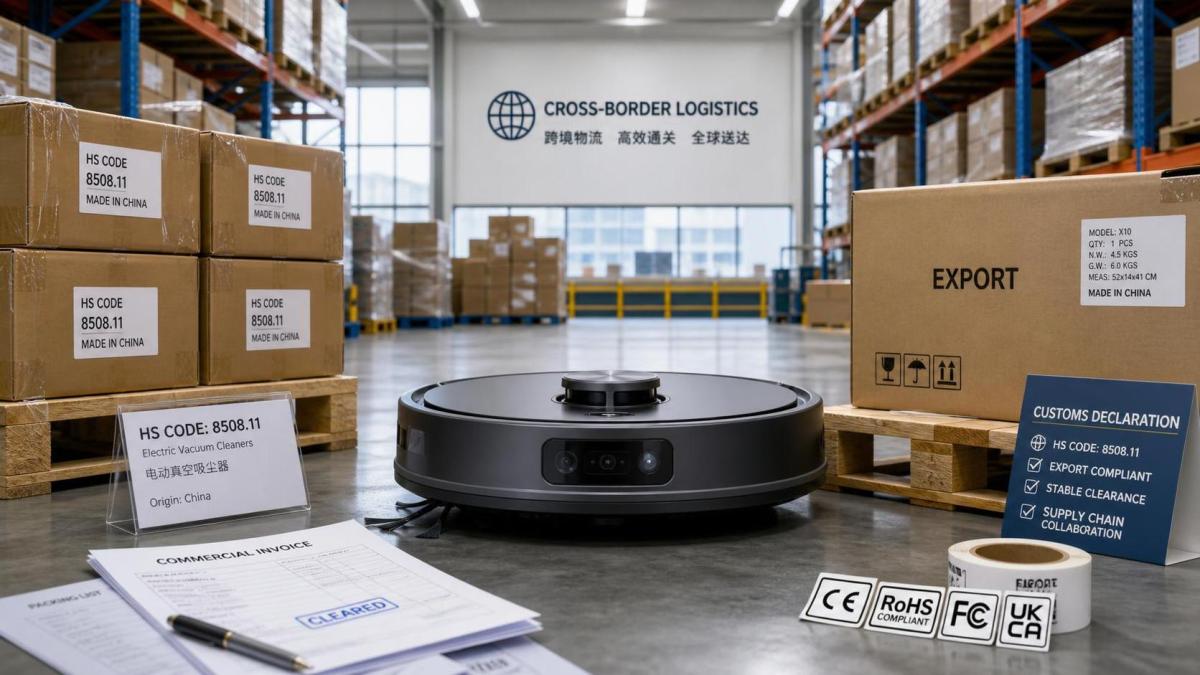
According to the information provided, China Customs formally introduced dedicated tariff lines 8508.1110 and 8508.1910 for cleaning robots from January 1, 2026. The coverage includes mainstream categories such as robotic vacuum cleaners.
The adjustment originated from a tax policy research recommendation by the Tax Collection and Administration Bureau of the General Administration of Customs (Shanghai) and was incorporated into the 2026 tariff adjustment arrangement.
The same information states that the finer classification has improved classification accuracy and declaration compliance. It has also reportedly supported a year-on-year export order increase of more than 50% for companies including Ecovacs.
For overseas importers, the stated effect is more stable customs clearance timing, lower risk of classification disputes, and a more predictable supply chain delivery rhythm.
Where the operational impact is likely to appear first
Export declarations and customs filing workflows
From an industry perspective, exporters are the first group likely to feel the practical effect of the new tariff lines because product classification sits at the front end of customs declaration. The main impact is likely to be seen in SKU mapping, declaration consistency, and supporting document preparation. What deserves closer attention is whether internal product descriptions, customs filing records, and shipment documents are aligned with the newly activated codes.
Importer purchasing and delivery scheduling
For overseas buyers and importers, the relevance is tied less to policy interpretation and more to execution reliability. Analysis shows that a more specific tariff classification can reduce friction around customs processing and dispute risk when products enter cross-border trade flows. In practical terms, buyers may need to review whether purchase orders, product specifications, and trade documentation are consistent with the new classification approach so that lead-time expectations remain realistic.
Logistics and compliance service providers
Customs brokers, freight forwarders, and other supply chain service providers may also be affected because classification accuracy influences declaration handling and clearance coordination. Observably, the change raises the importance of keeping filing language, invoice descriptions, and shipment records consistent with the applicable tariff line. Their role is not only procedural; it also affects whether delivery schedules remain predictable for both sellers and buyers.
Manufacturing and channel planning
Manufacturers and distribution partners may need to pay attention where export planning and order execution intersect. The information provided links the code refinement with better compliance and stronger export order performance in at least one named company case. Analysis shows that, for operational teams, the immediate relevance lies in whether planning assumptions for shipment timing, inventory turnover, and channel replenishment are updated to reflect a potentially smoother customs process.
What companies should review now
Check product-to-code alignment
Companies shipping cleaning robots should review whether their main product categories, especially robotic vacuum cleaners and similar mainstream items, are being mapped correctly to the dedicated tariff lines now in force. This is not a new certification requirement in the information provided, but it is a clear customs compliance checkpoint.
Reconcile commercial and customs documents
What deserves closer attention is document consistency across invoices, packing lists, customs declarations, and internal product records. Where classification becomes more specific, mismatches in wording or SKU references may create avoidable friction even if the broader product category is correctly understood.
Watch for implementation language and filing practice
Analysis shows that the current update is best read as an implemented classification change rather than a draft proposal. Even so, the input does not provide detailed execution guidance for every filing scenario. Companies should therefore keep watching for official wording, operational interpretations, and practical filing standards that may affect how the new tariff lines are used in day-to-day export work.
Adjust delivery and procurement coordination carefully
For exporters and overseas buyers, the information points to steadier clearance timing and lower classification dispute risk. It is more appropriate to understand this as a basis for better delivery planning, not as a guarantee of identical results across all transactions. Procurement and supply teams should monitor whether suppliers, brokers, and logistics partners have updated their handling processes accordingly.
Why this reads as an execution signal
Observably, this development is more than a general policy direction because the dedicated tariff codes have already taken effect from January 1, 2026 and were incorporated into the 2026 tariff adjustment arrangement. Analysis shows that the strongest signal here is execution: customs classification for cleaning robots has become more specific, and that has immediate relevance for compliance filings and cross-border delivery management.
At the same time, it would be premature to stretch the conclusion beyond the information provided. The current record supports the view that the rule change improves classification precision and lowers dispute risk, but market-wide implementation effects, operational consistency, and business response still need to be observed through actual trade practice.
How this update is best understood
This update is best understood as a rule change that has already landed and is now relevant to export operations, customs compliance, and importer planning in the cleaning robot trade. Its significance lies in clearer classification and a more predictable filing environment rather than in a broad claim about market outcomes. For industry participants, the rational takeaway is to treat the new tariff codes as an operational compliance development with direct effects on documentation, declaration accuracy, and delivery coordination, while continuing to watch how execution practices settle in.
Basis of this article and points still to verify
This article is based on the user-provided news title, event date, and event summary. For developments of this type, relevant source categories typically include official notices, releases from regulatory authorities, customs or trade administration information, industry association materials, standard-setting documents, and reporting by authoritative media.
A specific official source link was not provided in the input, so that part still requires follow-up verification. Ongoing observation should focus on any further policy detail, implementation wording, filing practice, changes in procurement or tender documents, industry feedback, and how companies apply the new classification in actual export operations.
Get weekly intelligence in your inbox.
No noise. No sponsored content. Pure intelligence.
 Sep 28, 2026How Hospitals Can Select Automated Hygiene Systems for High-Risk Care AreasHow Hospitals Can Select Automated Hygiene Systems for High-Risk Care Areas
 Sep 27, 2026How to Size a Single-Tank Ultrasonic Cleaner for Parts, Load Weight, and ThroughputHow to Size a Single-Tank Ultrasonic Cleaner for Parts, Load Weight, and Throughput
 Sep 26, 2026How to Size Cleaning Pumps for Shipyard Bilge, Hull, and Dock Washdown DutiesHow to Size Cleaning Pumps for Shipyard Bilge, Hull, and Dock Washdown Duties
 Sep 25, 2026How Facility Buyers Can Evaluate Commercial Cleaning Industry SuppliersHow Facility Buyers Can Evaluate Commercial Cleaning Industry Suppliers
 Sep 24, 2026How to Select Medical Instrument Cleaning Equipment for Complex Surgical DevicesHow to Select Medical Instrument Cleaning Equipment for Complex Surgical Devices
 Sep 23, 2026How to Evaluate a Municipal Sanitation Equipment Factory for Fleet ReliabilityHow to Evaluate a Municipal Sanitation Equipment Factory for Fleet Reliability
 Sep 22, 2026Selecting 500 Bar Waterjet Pump Systems for Concrete Hydro-Demolition ProjectsSelecting 500 Bar Waterjet Pump Systems for Concrete Hydro-Demolition Projects
 Sep 21, 2026Warehouse Route Optimization: Reducing Travel Time in High-Volume PickingWarehouse Route Optimization: Reducing Travel Time in High-Volume Picking
 Sep 20, 2026Selecting High-Capacity Industrial Washer-Extractors for Multi-Shift Laundry OperationsSelecting High-Capacity Industrial Washer-Extractors for Multi-Shift Laundry Operations
 Sep 19, 2026How to Size a Hotel Laundry System for Peak Occupancy and Linen TurnoverHow to Size a Hotel Laundry System for Peak Occupancy and Linen Turnover
 Sep 18, 2026How Fluid Dynamics Efficiency Shapes Cavitation Performance in Ultrasonic CleaningHow Fluid Dynamics Efficiency Shapes Cavitation Performance in Ultrasonic Cleaning
 Sep 18, 2026Municipal Equipment Trends: Why Cities Are Moving Toward Electric Street SweepersMunicipal Equipment Trends: Why Cities Are Moving Toward Electric Street Sweepers
 Sep 18, 2026Factory Cleaning Automation: When Autonomous Scrubbers Deliver Measurable ROIFactory Cleaning Automation: When Autonomous Scrubbers Deliver Measurable ROI
 Sep 18, 2026Industrial Cleaning System Design: Matching Water, Pressure, and Waste StreamsIndustrial Cleaning System Design: Matching Water, Pressure, and Waste Streams
 Sep 18, 2026What to Audit Before Partnering With an Industrial Cleaning System FactoryWhat to Audit Before Partnering With an Industrial Cleaning System Factory
 Sep 18, 2026Choosing an Industrial Hygiene Equipment Supplier: Service, Parts, and ComplianceChoosing an Industrial Hygiene Equipment Supplier: Service, Parts, and Compliance
 Sep 18, 2026How to Evaluate Industrial Hygiene Machinery Manufacturers Beyond PriceHow to Evaluate Industrial Hygiene Machinery Manufacturers Beyond Price
 Sep 18, 2026Equipment Washing Stations: Key Design Features for Safer Shift ChangeoversEquipment Washing Stations: Key Design Features for Safer Shift Changeovers
 Sep 18, 2026Chemical-Free Disinfection Systems: Where Steam and UV Methods Work BestChemical-Free Disinfection Systems: Where Steam and UV Methods Work Best
 Sep 18, 2026How Hospitals Select Contamination Control Systems for High-Risk Clinical AreasHow Hospitals Select Contamination Control Systems for High-Risk Clinical Areas
 Sep 18, 2026CCSS Explained: How Contamination Control Systems Protect Critical Clean EnvironmentsCCSS Explained: How Contamination Control Systems Protect Critical Clean Environments
 Sep 18, 2026How Often Should Ultrasonic Cleaners Be Validated for Medical Reprocessing?How Often Should Ultrasonic Cleaners Be Validated for Medical Reprocessing?
 Sep 18, 2026When Is Hydrodemolition Safer Than Mechanical Concrete Removal?When Is Hydrodemolition Safer Than Mechanical Concrete Removal?
 Sep 18, 2026Which Waterjet Nozzle Is Best for Removing Sewer Blockages?Which Waterjet Nozzle Is Best for Removing Sewer Blockages?
 Sep 18, 2026How Do Industrial Pressure Washers Compare With Chemical Cleaning?How Do Industrial Pressure Washers Compare With Chemical Cleaning?
 Sep 18, 2026Are Hot Water Pressure Washers Necessary for Oil and Grease Removal?Are Hot Water Pressure Washers Necessary for Oil and Grease Removal?
 Sep 18, 2026What Should Municipalities Check Before Buying a Vacuum Truck?What Should Municipalities Check Before Buying a Vacuum Truck?